Escamoteur is French for conjurer. Tourettes…well, you know what tourettes is. These are my occasional outbursts involving the weird little world of magic and mentalism. Mobile phone friendly.

Ouch.

Posted on June 18, 2008 5:18 am by John LeBlanc
Filed Under General | Leave a Comment

My chest hurts.

At my age, that’s not the best way to start polite conversation, but Casa Escamoteurettes isn’t exactly known for its politeness, now is it. Just to settle the nerves of the three of you I may have concerned, the pain isn’t due to cardiac what-not. I finished listening to Michael Close’s audio book, That Reminds Me: Finding the Funny in a Serious World.

I had planned to order the book from Lulu.com but my friend Jim Sisti suggested a few reasons why the audio book might be the better way to go.

For one thing, reading jokes can be fun (and funny.) But there’s a lot to be said for experiencing the delivery and timing, which often takes a joke into the stratosphere of laugh-out-loud funny. By way of example, reading the Congressional Record isn’t nearly as absurdly funny as watching my two favorite soap operas: CSPAN and CSPAN2.

Hearing Close’s delivery and timing should help my own. For instance, here’s a joke of mine:

I just drove in from Houston and boy is my truck tired.

(Go ahead and laugh, but it kills ‘em in redneck and hillbilly country.)

The book is only $20, and the audio book instant download (definition of instant relating, naturally, directly to how fast your broadband connection happens to run) is only $29. So, from where I sit, I paid $9 for Michael to hurt me. Where can you get a deal like that in Vegas, I ask.

Get it here.


Phone sax.

Posted on February 12, 2008 6:25 pm by John LeBlanc
Filed Under General | 2 Comments

I’ve noticed Casa Escamoteurettes is visited quite a bit by people sporting web-enabled mobile devices. This is good, so long as you higher-tech visitors are not trying to drive while reading this blog; you run the risk of crashing into that idiot turning in front of you who doesn’t see you because she’s busy tapping out a text message.

Lest I be considered a Luddite — and I have been called worse — I have mobile-device enabled this blog. Trying it out on my smart phone I find I can jog my memory with regards to things I’ve written in fewer downloaded bytes than checking Houston conditions on The Weather Channel’s web site. Technology good. Excessive bandwith charges, bad. We aim to please.

As for the sax, here’s a demo of the Jazz & Big Band library offered by the fine folks at Gary Garritan’s group. (I am quite the fan of these sample libraries, having invested (cough, cough) dollars in several sets.) This saxophone solo demo is described thusly:

This excerpt comes from a track from the Sirius B album “Casa do Sol” geaturing Tenor player is Iain Ballamy , one of the UK’s top Jazz musicians. Joe Cavanagh & Markleford Friedman have realized this sax solo using one of the tenor saxes in the Jazz and Big Band library as well as the fretted bass, electric piano and fusion drum kit.

It is sax. Is uses the word “Casa.” It satisfies my juvenile need to tie in the words “phone” and “sax” in an attempt to lure you here. It’s also a fine piece of music.


Deep impact.

Posted on February 11, 2008 9:48 pm by John LeBlanc
Filed Under General | 1 Comment

First, a quote:

“… well what I did was that I was the first one to just go out and just play steel guitar concerts and when I did it I didn’t just do it in the United States, I did it in England, and everybody kept on saying ” What are you going to sing?” and I would say “I don’t sing I just play the guitar and so I was the person who made that possible so in that sense I made the steel string guitar concert respectable. As for being the father of these other guitar player in any other sense, especially new age music, I do not want that appellation.” — John Fahey in an interview with Stefan Grossman

While listening to Led Zeppelin’s Kashmir at absurdly high sound levels is sure to make it a good day, there are times — more often these days — when something a bit less…bombastic is what I care to hear. (Right now, as I write this. Vince Guaraldi is treating me to Days of Wine and Roses. It is — and has been — a good day.)

It’s hard for me to imagine not listening to steel-string solo acoustic guitar. I absolutely fell in love with the sound when I happened upon a three year-old (and well-used) copy of Christmas with John Fahey, Volume 2. This is all the more surprising when one considers my listening choices at that time were the aforementioned Led Zeppelin, along with Aerosmith, Bad Company, Black Sabbath and AC/DC. Like my driving habits at the time (at any moment in time my 1972 Camaro knew only one of two states: sitting still or full-throttle) my listening habits required the volume knob to be set either to 11 on the dial or fully off. Ah, youth.

(I’m sorry, did you say something?)

I loved that album so much I listened to it year round — a habit I maintain to this day.

John Fahey’s style is called “American primitive guitar.” To quote from a piece written by Matt Hanks in the May/June 1997 issue of No Depression Magazine“the bimonthly magazine surveying the past, present, and future of American music”:

To borrow again from Stanley Booth (maybe he should be writing this piece), like every true original, John Fahey has a strong sense of tradition. The components of his muse — his steel string guitar, his country blues, his love of classical melodicism and dissonance, his fascination with railroads and other manifestations of the industrial age — all have their origins in the early 20th century.

(You can — and should — read the entire article, reprinted with kind permission, on John Fahey’s official web site.)

Later in that article Hanks makes an excellent observation:

…Fahey suffused tradition with his own talents so seamlessly that his innovations were often indistinguishable from homage, or even hoax.

Matt’s words made perfect sense to me. Later in life when I sampled and, subsequently, fell in love with some of the same music that stoked Fahey’s fire, I could find the threads in Fahey’s music that pulled from early 20th century guitar players. There was a call-back, but it was a lot more than that. He may have purchased his first guitar in an effort to meet chicks, but thankfully he managed to change the world of music in addition.

Fahey released his work on his own label, Takoma Records. Takoma was home to a number of like-minded, remarkably talented musicians, including Leo Kottke and Robbie Basho.

It was for Takoma Records that John Fahey first recorded George Winston. (I’ve written of my deep love of Winston’s music more than once.) The album Ballads and Blues was released to the musical ether in 1972, and came and went roughly in the same moment.

In 1979, William Ackerman — a truly magical guitar player — went to visit George Winston. William wanted to sign George to Ackerman’s new label, Windham Hill. While staying over that night, after playing lovely slack-key guitar stuff, George sat behind the piano and began playing the music that became the basis of his first Windham Hill release, Autumn, released in 1980.

1982 saw the release of Winston’s second Windham Hill hit. It was called, December — and it was my first George Winston album.

Winston’s music — like that of Fahey — drew from a wide range of styles and from a wide range of performers who came before, making up a part of the raw material that became the music magic.

Tonight marks one year since I’ve seen George Winston in concert. I first saw him at the Saenger Theater in New Orleans in December 1983. Last year I saw him in the wonderful little Manship Theater in Baton Rouge, LA. We were two of some three hundred in the audience, each of us seated close enough that no sound reinforcement on the piano was necessary. Twenty-four years after my first George Winston concert — and who knows how many between — I found the magic was as alive as that first night on Rampart Street in New Orleans.

Winston riffs on the masters — from Vince Guaraldi to Dr. John. Still, his work is identifiable with him. A George Winston album is uniquely George Winston, just as anything John Fahey played was…well, sounded like Fahey.

Few of us in the world of mystery entertainment have the capacity to literally invent. At best, we read and learn and appropriate from here and there, inject a part of our own DNA and, with a bit of stardust, synthesize a new something. The question I have is this: is the end result uniquely you? When you riff, is it you, or is it a clone of someone else? (In an effort to be a kinder, gentler John LeBlanc, I didn’t insert the word pathetic where it logically belonged in that previous sentence.)

Let us continue with this:

“…he stared intently at me as he told me of the frustration of being pursued for more than 30 years by people who thought he was a guru of some sort, people who thought their emotional response to his music meant that he had something to tell them, people who wanted something from him that he didn’t have and didn’t want to give them. He didn’t understand what people were talking about when they tried to tell him how his old music made them feel and what they thought it meant. He hated his old music, he wanted to do something different and he wanted people to be interested in it. He said his reputation as a misanthrope was all wrong, he just couldn’t stand being around stupid people, he needed to be around intelligent, stimulating people. “

He would like very much to make a lot of money, but he doesn’t want it badly enough to spend the rest of his life playing the music the aging idiot hippie component of his audience wants to hear. He doesn’t really hate his old music, he hates the artistic straitjacket represented by it and the expectations of a close-minded, nostalgic audience.

That’s…hard. And I put it here for two reasons, really. One of them should point you to present day magic superstars like David Copperfield and Penn & Teller. Compare the early days of each with what you see today. Is there a message in there somewhere that may contain valuable guidance? I think so.

In bringing this post to a close, in February 2001, just a few days before what would have been his 62nd birthday, John Fahey died at Salem Hospital after undergoing a sextuple bypass operation. Go here to read an interview Stefan Grossman did with John. And when you’re done, go here and read one of the finest articles written. It was written by Joe Piecuch.

One last note. Personal. Over the last couple of years I’ve written quite a few words that are posted to Escamoteurettes. (Granted, I did take quite a few long naps in 2007, so my words-per-week is a bit low as a result.) Few topics have made me feel as artistically insignificant and superficial as writing about John Fahey and George Winston and Ted Anneman as though I had clue number one. To my credit — I hope — at least I am aware of my cluelessness, if not the depth thereof.

Still, this is about a deep impact, and I’ve done my best.


Ninety degrees.

Posted on February 11, 2008 8:35 pm by John LeBlanc
Filed Under General | Leave a Comment

As I put the finishing touches on another Opus Escamoteurettes (which is to say, a blog post too long to read in one sitting in the head, but too short to bother killing a real tree in order to publish it properly) I want to share a reference with you in hopes you will consider the magnitude it wields in This Thing of Ours:

Haunted Pack — Psychokenesis
Devano Rising Cards — magic trick

The difference? 90 degrees.

That’s the message found on page 195 of one of the most important books I have on my shelves of mystery entertainment related books: TA Waters’ Mind, Myth and Magick.


Blackface Mentalism

Posted on January 31, 2008 12:36 pm by John LeBlanc
Filed Under General | 2 Comments

This post has been a long time coming.

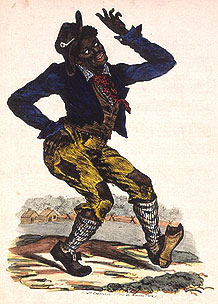
But first, some lyrics:

Wheel about, an’ turn about, an’ do jis so;
Eb’ry time I wheel about, I jump Jim Crow.
– Thomas Dartmouth “Daddy” Rice, Jump Jim Crow


Jimcrow.jpg

While Lewis Hallam is believed by some to be the first white comedian to perform in blackface (that was in 1789), and Robert Toll in Blacking Up: The Minstrel Show in Nineteenth-Century America suggests it was Charles Matthews, it is Thomas Dartmouth Rice who is often acknowledged as the “father of American minstrelsy” — the first white stage performer to wear blackface makeup (at the time, burnt cork applied to the skin to darken it) and successfully perform as a black man. That was around 1828. He is most often associated with the phrase Jim Crow, a circa 1828 caricature of a crippled plantation slave, singing and dancing.

(I fully realize asking the obvious question — why not just get a black actor to play the part of a black man? — short-circuits the long, circuitous route I enjoy so much taking in making whatever point I have in mind in these blog posts, so why not let’s just forget I brought it up.)

Although closely identified with whites masquerading as blacks, minstrelsy was also later performed by black actors, too.

From the Wikipedia entry:

Minstrel shows portrayed and lampooned blacks in stereotypical and often disparaging ways: as ignorant, lazy, buffoonish, superstitious, joyous, and musical. The minstrel show began with brief burlesques and comic entr’actes in the early 1830s and emerged as a full-fledged form in the next decade.

Minstrelsy presented a version of black people that was based on exaggerated stereotypes. White actors playing the part of black people doing the sorts of things no one was actually doing. If there was anything to make it worse, its when black actors played the part of white actors playing the part of black actors doing things no one actually did in real life. (How’s that for convoluted?) The wild popularity of minstrel shows contributed to creating some of the racial epithets we carry with us to this very day. Once an idea takes hold, it’s almost impossible to blot out.

Allow me to be blasphemous for a moment: mentalism is a branch — a form — of magic. Now, I know that just irritates the snot out of some people, but it’s a fact hard to get around. Still, mentalism has a fit and form all its own — a face, if you will — that we know when we see it.

There is a growing contingent in the mystery entertainment world that suggests much of what passes for “mentalists” and/or “mentalism” is, for all intents and purposes, nothing more than magicians masquerading as real mentalists. And, I detect, the problem is not so much the lowly magician encroaching as it is magicians presenting a form of mentalism that is not genuine, real mentalism but, rather, a demeaning caricature.

What is real mentalism? I’ll give you a hint: it doesn’t matter what we think it is, it’s only what audiences think it is. (And they don’t use the word mentalism anyway.)

If, in the world of blues guitar, Clapton is god, then in the world of mentalism, Annemann is god. From one end of the mentalist landscape to the other, Annemann’s work — especially The Jinx — is pointed to as seminal work. Max Maven is reported to consider the writings of Ted Annemann the greatest historical influence on his work. (M-U-M March 1979).

From the innaugural issue of The Jinx, October 1934:

“Conceived, written and published by Theo Annemann, The Jinx is not a magazine, neither is it a crusading sheet with a chip on its shoulder and a woodpile in reserve. All offices, both in an artistic and business sense are held by one individual who has but a single thought in mind, that of supplying magicians and mystery entertainers at large with practical effects and useful knowledge.”


Bob Cassidy
points to Henry Hays’ Amateur Magicians Handbook and states it was his “gateway into the world of magic and my first step to mentalism. It would be another five years before I heard of a guy named Corinda.” (Hay’s book is one of Cassidy’s “The Thirty-Nine Steps — A Mentalists Library of Essential Works.”)

Richard Osterlind regularly points to the Tarbell Course in Magic as a rich source of mentalism.

I could go on, but, at this point, I’m either preaching to the choir or talking to a wall.

People like John Edward and Sylvia Browne chap my base because they present a front that I consider an affront. In a very pleasant conversation I had recently with a cyber crime specialist in the Federal Bureau of Investigation, I made note that I consider what people like Edward and Browne do should be criminal. Unfortunately, I can only offer my opinion that their actions are morally and ethical corrupt.

How far between “mental magic” and Edward and Browne are your beliefs? Just asking.

It’s worth noting that Rice, the original Jim Crow, became rich and famous because of his skills as a minstrel. He may have lived “an extravagant lifestyle,” when he died in New York on September 19, 1860, he died in poverty.

One last note: Rice’s brand of entertainment would later be considered a form of racism, although it also opened the door for black performers.


Tap. Tap. Tap.

Posted on June 28, 2007 6:49 pm by John LeBlanc
Filed Under General | 2 Comments

I thought about attempting to break my own record at how long I can go without peeping, but what’s the fun in that? So, instead, I thought I’d try an experiment that may interest some of you.

Suppose you could learn what are, for lack of any better way to describe them, the “secrets” (and I’m no fan of that word) of earning a rather substantial pile of shekels in exchange for performing this weird little thing of ours? Of course, they aren’t really secrets at all; I’ll simply point you in the right direction and add a bit of commentary.

Over the last ten years or so I’ve been compiling notes for a project that has never seen the light of day. I’m thinking this might be the appropriate venue for sharing that notebook-and-a-half of mine.

Yes, that might be gratifying.

In the mean time, my friend Jim Sisti has been sharing a few gems that, if you were to read between the lines, provides imporant insight in the business of magic. Visit here.


The Lonely Bull

Posted on March 31, 2007 11:03 pm by John LeBlanc
Filed Under General | 1 Comment

Happy 72nd birthday, Herb.


Don’t look, Ethel.

Posted on March 14, 2007 10:32 pm by John LeBlanc
Filed Under General | 2 Comments

First, a quote:

Here he comes, boogie-dy, boogie-dy
There he goes, boogie-dy, boogie-dy
And he ain’t wearin’ no clothes

Oh yes, they call him the streak
Fastest thing on two feet
He’s just as proud as he can be
Of his anatomy
He’s gonna give us a peek
Oh yes, they call him the streak
He likes to show off his physique
If there’s an audience to be found
He’ll be streakin’ around
Invitin’ public critique…

–Ray Stevens, The Streak

In keeping with the spirit of this post, Here’s a YouTube clip providing the original — superior — version of the song, accompanied with a video that is…pure entertainment. Brilliant:

1974 was a bizarre year for several reasons. Patricia Hearst is kidnapped; Phillip K. Dick has his wisdom teeth extracted and, upon answering the door for a delivery of painkillers, sees a pendant around the neck of the delivery woman and begins seeing visions (to be fair, though, that’s not the weird part); The Brady Bunch is canceled (“Marcia, Marcia, Marcia”); ABBA, Waterloo; the Darwin Beer Can Regatta (honestly, now, do you even need to click the link?); and one name: Ronald DeFeo, Jr..

Certainly one of the more culturally bizarre was the practice of streaking. According to Wikipedia:

Streaking is the non-sexual act of taking off one’s clothes and running naked through a public place.

When you are aged three and younger, that’s considered fairly normal behavior. After that, apparently, the rules change significantly and materially.

(Sorry to be the bearer of bad news, but not everything is beautiful.)

As bizarre as streaking might have been viewed — and, frankly, it did not disturb me all that much given the fact that the only streakers I personally viewed were of the fairer sex (a fine example of the fairer sex) — it served a purpose: to draw attention to the streaker. That’s it. You can go home now.

Through the intervening years, young people have attempted and implemented various cultural devices by which they might draw undue attention to themselves. Maybe it’s just me, but streaking trumps a blue mohawk every day and twice on Sunday, especially if the streaker is a redheaded chick. (Again, maybe that’s just me.)

But the point, really, is attention. Since a tree falling in a forest with no one there to hear it clearly makes no noise, winking in the dark doesn’t accomplish a whole lot more; you have to have an audience.

Enter YouTube.

YouTube can be to magicians with a video camera, what a Super Bowl halftime commercial is to advertisers — a guaranteed audience (only a lot less expensive.)

YouTube also can be to magic and mentalism what Allen Funt was to people who unwittingly do stupid things. And to just as frighteningly large an audience. On demand.

YouTube further supports the notion that Johannes probably had the last laugh.

YouTube, like the Internet and, specifically the Worldwide Web on which YouTube relies, is a conduit for information. Put a search box on the conduit and you have a double-edged sword. Allow anyone with the ability to upload a video and you have one example after another of someone falling on their own double-edged sword over and over and over and…

(The pen may be mightier than the sword, but it’s not nearly as much fun watching someone falling on his own pen as the other thing.)

Anything wrong with that? If the InnernetWeb can’t amuse, why bother paying $80 a month for 10MB download speed?

In the larger picture of things, yes, there can be something wrong with that. Magic and mentalism is not easy to do. It’s even harder to do well. Doing it great? Few do. By default, YouTube falls in line to prove Theodore Sturgeon correct. Hey, it’s not just a good idea, it’s the law, man.

The good Mr. Sturgeon’s corollary states:

“The existence of immense quantities of trash in science fiction is admitted and it is regrettable; but it is no more unnatural than the existence of trash anywhere.”

True. But that doesn’t ameliorate the wounds, now does it? That’s not much better than “misery loves company” (although this version is far superior.)

While Joseph Juran may have cared about the law, he was also a principled man. He thought enough of Vilfredo Pareto’s observation that 80% of income in Italy went to 20% of the population, that he named the Pareto Principle after Pareto. The Pareto Principle is known worldwide, though under the more familiar “80-20 Principle” — 80% of the results come from 20% of the effort. (Helpdesk people will tell you 80% of the calls come from 20% of the customers, but that’s another blog post for another day.)

Combine Sturgeon’s Law with the Pareto Principle and we can safely suggest that 80% of the people searching for magic on the Internet will find the 20% of videos most easily displayed on YouTube to represent the 90% of crap they fully expect it to look like to begin with. Further, it might be safe to state that 20% of the good videos represent 80% of the views they may never get while people are viewing the other 90% of the crap you find on YouTube.

Or something like that.

Is there a solution? Hmmm. I’m not so sure there’s even a problem. Allow me, please, to explain.

There are some in the world of magic and mentalism who hold the position that, to perform any piece publicly in a less than a well constructed, fully practiced manner injures magic in the same way the culturally popular death of a thousand cuts can. If that were true, magic would have died a hundred years ago. (Here is where the obligatory and fully appropriate link to Max Maven’s Protocols of the Elders of Magic should appear. But let’s not throw a rock at that bee’s nest, shall we?)

Another faction suggests that we “old guys” are loathe to throw away our buggy whips (not to mention the buggies) in favor of embracing more modern transportation. To that I can only say you’ve never had to walk back and forth to to school, uphill, both ways, in the snow. So don’t pour me a glass of water and tell me it’s raining.

Yet another faction suggests YouTube is The Next Step in successful marketing. (But, marketing what? Who cares! “Two million views is two million views Mr. I had To Ride My Dinosaur To School.”)

In his book, Engineering Persuasion, Richard Bandler and John La Valle make the point:

When you look at the selling process, we like to start from the end. Many sales training programs start with the beginning of the process. After all, when you know where you’re going, it’s much easier to get there. Then you run the process backwards for yourself so you know what steps you take to get there.

Start with the end in mind. In other words, “what’s the goal?”

What’s the goal of a magician posting a video to YouTube? If it is merely to feed an ego, then not much more thought needs to be considered. If the goal is loftier than that, it may be a good idea to clone another aspect of David Blaine’s success: get a director. Or at least someone who can tell you the truth without you going on a digital rampage posting paragraph after paragraph explaining why your reviewer doesn’t know his nostril from a hole in the ground.

Just a suggestion. But what do I know? I have to feed my dinosaur now.


Short and sweet.

Posted on March 11, 2007 12:41 am by John LeBlanc
Filed Under General | Leave a Comment

I can think of several reasons why I like Richard Kaufman. This evening one of those reasons decussated the unspoken reason I have yet to view the motion picture The Prestige:

The editing and twisting of the narrative wasn’t hard to follow, but watching a film over two hours long about two asshole magicians who are a pair of conceited bastards was extremely tedious.
Richard Kaufman

Sure, it’s still on my Netflix queue (it was recommended by a few friends, though I’m now wondering if there was some underlying motivation over which I should be offended) but it’s not a priority. Instead, I’m looking forward to a viewing of How to Eat Fried Worms. Now there’s a plot I can sink my teeth into.


The nicest guy in rock and roll.

Posted on March 10, 2007 9:38 pm by John LeBlanc
Filed Under General | Leave a Comment

Brad Delp
June 12, 1951 – March 9, 2007

Remembering Brad Delp
Delp remembered as generous, unassuming star

UPDATE: I’m going to add this quote, currently the home page of the web site for the band Boston. I’m posting it here because it’s not likely to stay there, but it should remain visible:

As you all know by now, BOSTON’S lead singer, Brad Delp, was found dead in his home on Friday, March 9th 2007. Plans for live BOSTON performances this summer have, of course, been cancelled.

My heart goes out to his wonderful fiance Pamela, his two children and other family members, his close friends and band mates, and to the millions of people whose lives were made a little brighter by the sound of his voice. He will be dearly missed.

–Tom Scholz

Indeed.


Find It


Recently


Archives

Content copyright protected by Copyscape website plagiarism search Listed on BlogShares

FireStats icon Powered by FireStats